Stories from Our Holocaust Testimony Archives
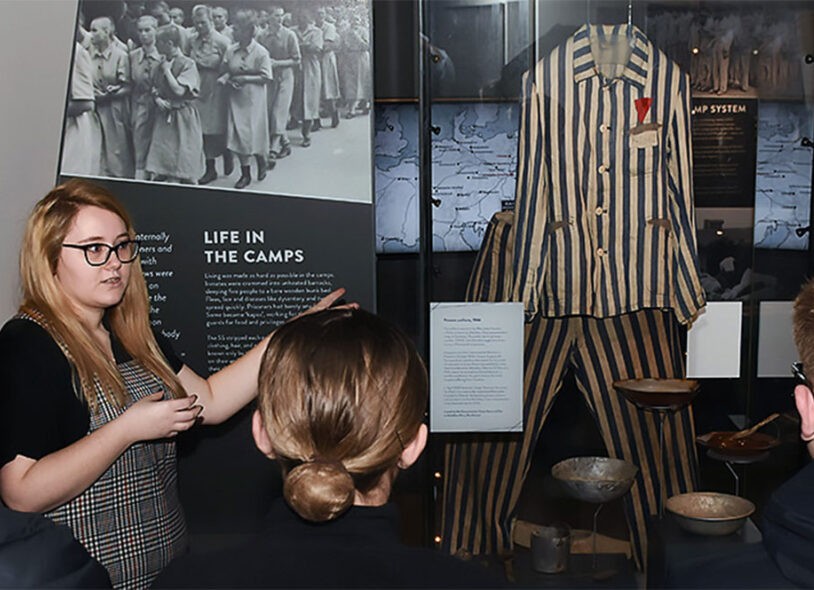
Drawing on powerful material from AJR Refugee Voices and AJR My Story, the below exhibition highlights personal testimonies, photographs and documents from Jewish refugees who fled Nazi persecution and rebuilt their lives in Britain. The exhibition theme will change throughout the year, offering fresh perspectives from our unique testimony archive.
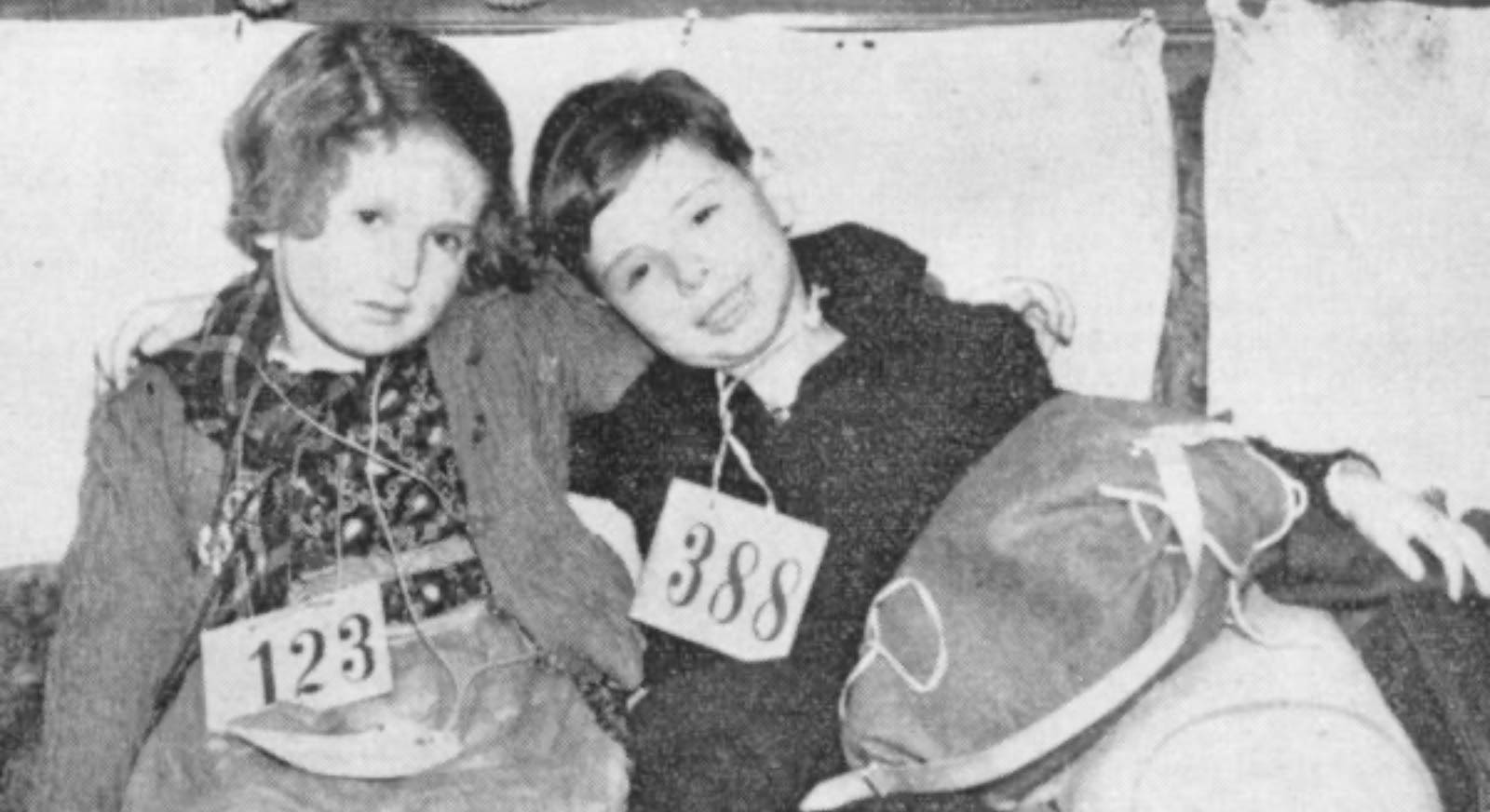
The Kindertransport
This collection illuminates the experiences of children rescued by the Kindertransport. The Kindertransport was a rescue effort between 1938 and 1939 that brought around 10,000 mostly Jewish children from Nazi-controlled territories to safety in Britain after the rise of Nazi persecution.
27
Members over 100 years of age
+300
Holocaust testimony videos
4
Visits from the King to the AJR
“It was so interesting and incredibly useful listening to Holocaust educators from around the world sharing ideas, challenges, and new ways to reach the next generation in what is now a very different time and world. The insights and conversations have reinforced just how vital it is that we continue to adapt, learn, and find new ways to ensure the lessons of the past remain alive and relevant.”
“Thank you for visiting us yesterday. We thought the meeting went brilliantly. We are so lucky to have a social worker as gentle, understanding and caring as you. We really appreciate all the support and advice you give us.”
“Thank you so much for putting on such an amazing event. I’ve found documents about my grandparents that I hadn’t seen before, including my dad’s name on a Kindertransport list. I can’t tell you how much it means to me and my family and thank everyone at the AJR for all you do.”
“My client arrived on the Kindertransport as a small child. Her husband passed away many years ago, and she does not have children. I visit her each week and we talk about current affairs over coffee and cake, and quite often we go out for lunch together. She recently told me that she had forgotten that I was her volunteer and referred to me as her friend! That’s why I love being a volunteer for the AJR.”
1,857
AJR Members of whom +600 are 1st generation, of which 30 are over 100 years old
+£8m
Directly allocated to members for homecare and other support services
69,599
Minutes of face-to-face volunteer support in the last 12 months
Upcoming Events
Hungarian Speaking Group
Exclusive Online Talk for AJR Members
- Online
- 14 Sep 2026, 4:00 pm
- Find out more
Latest News
4 September 2026
FROM THE EDITOR: THE SEPTEMBER JOURNAL IS HERE
Jo Briggs, Editor, AJR Journal In Spring 1939
4 September 2026
‘I escaped Vienna on the Kindertransport 87 years ago. Now, aged 99, I’m returning’
By Etan Smallman – Daily Telegraph As passengers
3 September 2026
Nazi persecution robbed them of their b’nai mitzvah. Decades later, they will finally stand at the bimah
For Holocaust refugees and survivors who were forced
At the beginning of September 1939, Nazi Germany invaded Poland, triggering the outbreak of the Second World War.
Approximately 100,000 Jewish soldiers served in the Polish armed forces, bravely defending their country against the German attack. As the invasion advanced, hundreds of thousands of Polish Jews were forced to flee eastward seeking safety. However, their escape was cut short on September 17 1939, when the Soviet Union invaded from the east, trapping refugees between two occupying powers.
Upon taking control, Nazi authorities targeted the Jewish population with public terror, forced labour and severe anti-Jewish decrees. These brutal measures marked the beginning of systematic persecution that would ultimately destroy Polish Jewish life and claim millions of lives across Europe.
Today marks the 87th anniversary of the final German Kindertransport via train and ferry to the UK. It’s also the anniversary of the 9th Czechoslovak Kindertransport which did not arrive here. Some of these children did survive the Holocaust in Prague and in Sweden but many of them perished. There were some children who escaped here from the Netherlands in May 1940 but they came on a ship. The ferry which brought the children over on the final transport 87 years ago today was the Amsterdam.
“I had the best incubator: my mother.”
Holocaust survivor Eva Clarke BEM recounts her miraculous birth at Mauthausen concentration camp on April 29, 1945. Her mother gave birth on a coal wagon while surrounded by prisoners dying of typhus, convinced it was her last moment on earth.
Against all odds, both survived thanks to two chilling twists of fate: the Germans had run out of gas for the chambers the day before Eva was born, and the US Army liberated the camp just days later. Weighing only three pounds, Eva survived without medical equipment simply because her mother held her close constantly, providing the warmth and love that kept her alive.
A special lunch with Holocaust survivor Jacques Weisser and Romy 💙
Jacques was just two and a half years old when his mother was deported from Antwerp to Auschwitz. He survived the war hidden by a Catholic woman in the Ardennes.
Sitting down together, Jacques reflected on how simply sharing a meal with loved ones is a privilege that millions were denied - a powerful reminder of gratitude, memory, and the importance of passing these stories on.
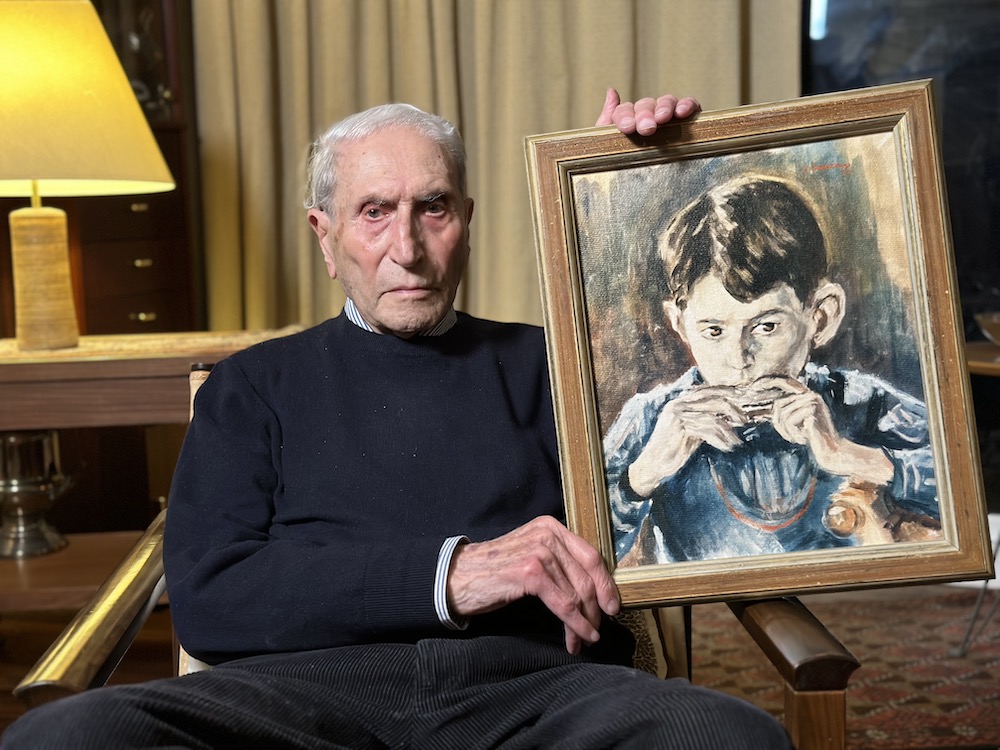
Born in Sosnowiec, Poland, in 1927, Harry Olmer MBE survived multiple Nazi forced-labour and concentration camps during the Holocaust, including Płaszów, Skarżysko-Kamienna, Buchenwald, Schlieben and Terezín.
After liberation in May 1945, he came to the UK as one of ‘The Boys’, a group of child survivors brought to Windermere to rebuild their lives. He learned English, qualified as a dentist and spent decades dedicated to Holocaust education.
In this powerful reflection, his granddaughter Chloe Kaye recounts a specific, poignant moment from his time in Windermere, showing how deep the trauma of starvation ran even after reaching safety. By sharing these personal memories, she keeps his history and the enduring resilience of survivors alive for future generations.
“Judge people not by the cover, but what’s inside the cover.”
Holocaust survivor Peter Summerfield BEM and his grandson Harry Sassoon share their timeless advice for the future, reflecting on character, empathy and the power of passing lessons down generation to generation.
Together, they emphasise their shared motto of ‘never again’ and the strength of standing united against hatred. Harry reflects on the current rise in antisemitism, highlighting how vital it is to keep survivor stories alive to remind us why we must continue striving for a better, more compassionate world.
“They came back crying and said they were no longer allowed to play with us… They said there was something about you being Jewish.”
Holocaust survivor Peter Summerfield BEM shares a heartbreaking childhood memory from 1930s Berlin, illustrating how anti-Jewish prejudice tore apart innocent childhood friendships.
He recalls the sudden shift when his regular playmates, the building caretaker’s young sons were forbidden from seeing him simply because he was Jewish. Even as the caretaker expressed his helpless regret, the pervasive fear of being sent to a concentration camp meant neighbours were terrified to disobey Nazi orders, leaving a young Peter isolated in his own home.
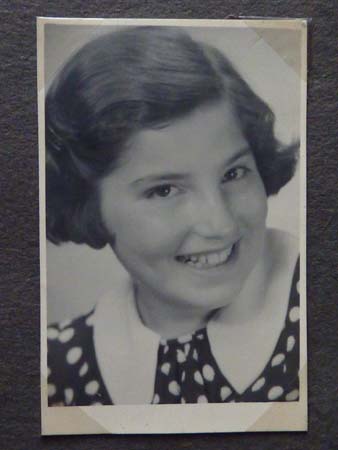
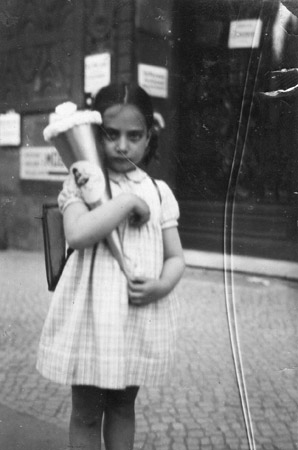
Gabriele was born in Vienna in 1926.
Her mother was Christian but she was unaware that her father was Jewish until she was forced to leave her convent school and wear a yellow star. She never saw her father again after Kristallnacht. Her grandmother made arrangements for her to leave Austria on the Kindertransport. She studied at teacher training college, and later became headmistress of a school in her home town of Newcastle. She married and had children who often returned with her to visit her grandmother in Vienna. Gabriele was appointed BEM for services to Holocaust education.
Read Gabriele’s fully story in the My Story section on the AJR website.