By Dr Bea Lewkowicz OBE, Director of AJR Refugee Voices
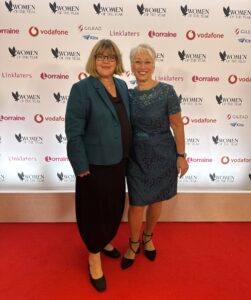
On 12 October, I had the great privilege of being invited to the Women of the Year Lunch & Awards 2026 in London, where I was recognised for my work as an oral historian and Holocaust educator, and for my contribution to recording and preserving the life stories of Holocaust survivors and refugees for the AJR in the last 25 years.
Founded in 1955, Women of the Year celebrates women whose achievements, courage and determination have made a lasting difference to society. Bringing together some 400 extraordinary women from diverse backgrounds and professions, the lunch was a powerful reminder of the many ways in which women shape our world, challenge injustice and inspire change. Each woman had her own remarkable story, making it an afternoon of inspiring encounters and conversations.
One of the most powerful moments of the afternoon was hearing Gisèle Pelicot, who received the ‘Woman of Courage’ Award, presented by actress Sienna Miller. Her extraordinary courage in speaking out against sexual violence, and her determination that shame must change sides, were deeply moving. She said: “Courage can take many forms: speaking out, standing up for someone else, refusing to accept injustice, listening to and believing a victim.” She concluded that courage can sometimes mean simply finding the strength to carry on. Her words resonated strongly with me and made me think of the courage of the many women I interviewed, who came as refugees or survivors from the Holocaust to the UK, and who often had to overcome many obstacles in their lives.
The afternoon also brought an unexpected encounter.
One of the first people I spoke to when I picked up my name badge was Gloria Ogborn OBE, whose mother, Anne Senchal (née Marschner), was one of a small group of deaf Jewish children rescued from Nazi Germany on the Kindertransport in July 1939. Their story is a remarkable and relatively little-known chapter in the history of Jewish refugee children who found sanctuary in Britain.
Anne was born in Berlin in 1929 and attended the Jewish School for the Deaf (Israelitische Taubstummenanstalt) in Berlin- Weißensee, together with her older brother Horst. As Nazi persecution intensified, the school’s headmaster, Dr Felix Reich, worked to secure the children’s escape. In July 1939, he accompanied a group of nine deaf Jewish pupils, including Anne and Horst, to Britain. The group became known as the Deaf Kindertransport.
On arrival in Britain, the children were taken to the Residential Jewish School for the Deaf in south London. Yet their difficulties did not end with their escape. Anne, who had learned German Sign Language, initially struggled to communicate with those around her because British Sign Language was different. She also experienced painful separations and considerable hardship as she adjusted to life in a new country. For deaf refugee children, the challenges of displacement were compounded by communication barriers and the limited understanding of their needs.
Gloria and her mother Anne had attended the AJR Remembering and Rethinking Forum on the Kindertransport in 2019 and I clearly remember Anne talking about her experience as a deaf Kindertransport refugee, an experience which is usually not widely discussed.
Talking to Gloria at the Women of the Year event, I learnt that she was awarded an OBE in the 2026 New Year Honours for services to British Sign Language and Deaf Communities. She worked as a British Sign Language interpreter for more than 35 years, and has specialised in legal interpreting, working as an expert witness and trainer and helping to improve access to the justice system for deaf people. In July 2022, she made history as one of the first British Sign Language interpreters to interpret in a jury deliberation room, following changes to the law allowing deaf people who use sign language to serve on juries.
My encounter with Gloria reinforced my belief that we should not only celebrate the profound impact of the refugee and Holocaust survivor generation on British society but also recognise and value the contributions of subsequent generations. The children and grandchildren of those who found refuge in Britain have made their own significant contributions across many fields. Their achievements are part of the continuing story of the refugees and survivors who rebuilt their lives in this country. Gloria’s remarkable work in advancing the rights and inclusion of deaf people is a powerful example of this legacy.