
On 15 September 1935, the Nuremberg Laws were introduced in Nazi Germany, defining Jews by ancestry, denying them full citizenship and prohibiting marriage between Jews and non-Jews. It is less well known that six years later, on 9 September 1941, the government of Nazi-allied Slovakia issued its own ‘Jewish Code’ (Židovský kódex). Its extensive regulations defined who was legally considered Jewish and excluded Jews from work, property ownership and much of public life. This was a turning point for the fate of the Jews in Slovakia, ultimately leading to the deportation of some 58,000 Jews to Auschwitz and the Lublin area in 1942. It is estimated that only around 300 people survived these deportations.
Since 2002, 9 September has been designated in Slovakia as a special Remembrance Day for the Victims of the Holocaust and Racial Violence.
I had the privilege of helping to arrange and participate in two memorial events in Bratislava and Žilina on the occasion of the 85th anniversary of the introduction of the Jewish Code. Both events were organised by the Slovak Ministry of Education, in partnership with the AJR, the Embassy of the Slovak Republic in London, the British Embassy in Bratislava, and the Central Union of Jewish Religious Communities.
These events were organised for high-school students, who were invited to IMAX cinemas in Bratislava and Žilina to first watch the film The Auschwitz Report by Peter Bebjak, and then listen to the stories of two descendants of Holocaust survivors from Slovakia. AJR member Vivian Hassan-Lambert told the story of her mother, Erika Hassan, and I relayed the story of my mother, Gertrud Friedmann.
Both our mothers survived the Holocaust in hiding as children. While Erika was separated from her sister and mother, Gertrud remained together with her parents and sister throughout the years from 1942 to 1945. It was very special to present their stories together, as Erika and Gertrud found themselves in the same town, Piešťany, in 1945. They were part of a small group of children who had managed to survive. Erika left for the USA in 1946, and the two women never met again.
A few years ago, I gave a talk for an AJR Holocaust Memorial Day event about Slovak survivors in the AJR Refugee Voices Archive. Erika, who lives in Los Angeles, spotted a photograph of my mother and immediately recognised her, which led to Vivian contacting me and ultimately to our trip to Slovakia.
Our first stop in Žilina was at the memorial erected on the site of the former transit camp. It is estimated that 26,400 Jewish men, women and children passed through this camp before being deported to Auschwitz and camps in the Lublin area. It was very special to stand there in silence in the early morning and lay a wreath on behalf of the AJR.
While I had shared my mother’s story before, it was quite unique to share it with 18-year-old pupils in the place where this history happened. The IMAX cinema in Žilina was just a mile away from my great-uncle Armin Winter’s flat, opposite the Jewish cemetery, where my mother lived for two years under the protection of her uncle. He had a special exemption from deportation, as he was deemed ‘economically important’ because he was the manager of a liquor factory. At one point, 12 people were hiding in his flat.
The cinema was also close to the former Jewish Old Age Home, which gave refuge to the two Slovak escapees from Auschwitz, Alfred Wetzler and Rudi Vrba, whose story is told in The Auschwitz Report, and whom my mother encountered in Žilina in April 1944, when she was asked by her uncle to bring food to the two escapees.
The event in Bratislava was attended by various dignitaries, including Tomáš Drucker, the Minister of Education, Research, Development and Youth of Slovakia, and the British Ambassador, Bilal Zahid, who both stressed the importance of remembrance and understanding history, as well as Member of Parliament Paula Puškárová.
In my address, I gave a short history of the AJR, mentioning that the AJR currently has 86 members connected to Czechoslovakia and that it supports Holocaust education in the UK and abroad, including through its involvement with IHRA. I also mentioned that the Refugee Voices Archive has captured eight testimonies with refugees and survivors from Slovakia and that we would be very interested in bringing these testimonies to schools and other educational institutions.
I finished my remarks by saying that the AJR is organising a heritage trip to Slovakia in early April 2027, which is almost fully booked, and that we are looking forward to discovering more about our shared Jewish-Slovak history.
It was a true privilege to meet young students on both days, who were genuinely interested and asked us thoughtful questions. The students thanked us for coming and for sharing our stories. After each session, a number of students came to us with more questions. Some wanted to tell us about their own family stories, some wanted to record us for their school projects, while others wanted to know what we thought about the rise of parties supporting anti-immigration policies across Europe.
One day after we returned home, the young woman from the Ministry of Education, Lubka Hankovská, who had helped to organise the events and who had so politely and diligently assisted us with the logistics during our stay, posted the following on her LinkedIn account:
Anyone who knows me knows that I have always been fascinated by history. The Second World War and the Holocaust, in particular, have always held a special place in my interest – not only because of their historical significance, but above all because of the questions this chapter of history has always raised for me. How can a society reach a point where something like this becomes possible? Why do some people remain indifferent, while others become complicit, and still others are willing to risk their own lives to help? … I am incredibly grateful to have had the opportunity to work with Bea and Vivian – two remarkable women who carry powerful stories of their families and have the courage to keep sharing them. The further in time we move away from the Holocaust, the more important it becomes to preserve not only the facts, dates and numbers, but above all the human stories.
While working on this project, I found myself returning to a question that has always stayed with me: what determines how a person will act when their values are truly put to the test? Research into those who rescued persecuted people during the Holocaust shows that empathy, solidarity and moral courage do not simply appear at the moment we suddenly need them. They are shaped long before that – by our upbringing, our experiences, our relationships with others, and the values by which we live. History itself does not make decisions. People do. And fear has an extraordinary ability to shift the boundaries of what we considered unacceptable only yesterday. This is also why I believe it is so important to speak about these subjects with young people.
I am grateful that, through a series of educational events… we can bring students not only a screening of The Auschwitz Report, but above all the opportunity to encounter authentic stories of people whose families were directly affected by the horrors of the Holocaust. Because personal testimony is something no textbook can ever fully replace.
I was very moved by Lubka’s words about the power and importance of personal testimony. After this visit, I feel I understand better why so many refugees and survivors have returned to their countries of birth and engaged in dialogue with as many young people as they could.
Through remembrance and dialogue, the ruptured past of our families cannot be changed, but it can, in some way, be returned to the landscape and collective memory from which it was taken and, in that way, become a new site of memory, connecting past, present and future generations.
I look forward to returning with the AJR group in April 2027 and continuing the conversations that began during this September week in Slovakia.
Dr Bea Lewkowicz OBE
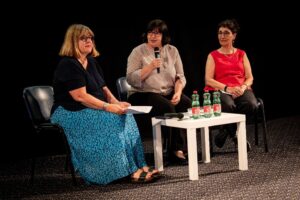
Dr Bea Lewkowicz, Zdenka Tanacova Dubanova, and Vivian Hassam-Lambert