On 10th October 2024, just four days into my fellowship, I found the Kindertransport lists at Yad Vashem, Israel. Then in the summer of 2025 I was appointed to my new role at the AJR. While I knew that I was going to be involved in the AJR’s historical and commemorative efforts in the lead-up to the 90th anniversary of the Kindertransport in 2028 I didn’t anticipate all the other incredible opportunities the role would bring my way. So, a year on I want to share what I’ve learnt through working at the AJR.
My role in the beginning few months was concentrated on data collection. I knew from my time at Yad Vashem, the National library of Israel, the Ghetto Fighters’ Museum, Kibbutz Lavi, and many more amazing museums and archives in Israel that the Kindertransport files were scattered all around the world. I needed to continue the research that I’d begun. The AJR funded me to visit archives in the Netherlands, the Czech Republic, France, and Belgium. These were my first research trips. What was really special was that I was joined by AJR members along the way.
To begin, my trip to the Netherlands would not have been so successful without Sue Mumford-Smeding. Sue had worked at the Anne Frank Museum and knew the lay of land in terms of Dutch Holocaust memory. She was my travel guide and connected me with her colleagues, especially those at the Dutch National Holocaust Museum and Westerbork. Sue came with me to the National Archives in The Hague where we sat together going through Kindertransport files. It was there that I showed her her mother’s Kindertransport list. As Sue speaks Dutch, she helped me navigate the files as there were documents about Kinder who went to the Netherlands on Kindertransports, those who came to Britain, and those who were in the Netherlands, but who then left for the UK and Belgium. The Dutch had only recently opened their files about those who had collaborated, so we were sitting opposite families who were finding out about what their families had done during the war. We were looking at stories of exile, going into hiding, deportation, and murder. While I was in The Hague, I also got to visit the former office of the Dutch border guards who gave the Kinder permission to cross the frontier. Standing outside the building with Sue is a moment I won’t forget because it was there that history happened – the Kinder would be free.
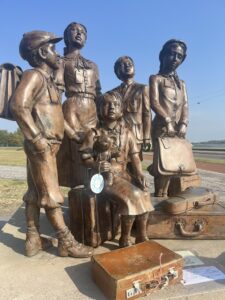
Sue also took me to the Hook of Holland to see Frank Meisler’s Kindertransport memorial. There we placed Sue’s mother’s suitcase and files which she carried with her on the Kindertransport – that was another moment I never thought I’d experience when I began the role. I was watching the sunset across the channel where the Kinder took their last steps in Continental Europe before boarding the ferry to come to the UK. Sue also accompanied me to Westerbork. We visited the museum, the former camp, and the archives. In the archives I found files of the Kinder who remained in the Netherlands who were then sent to Westerbork. I was emailing their families in America with the news! I cannot stress how important it is for me to visit these sites of memory. I always leave with a deeper sense of understanding and drive to carry on learning more. I also went to Vught which was a surreal experience. As you walk to the camp you pass a lake which families often use in the summertime. Just like Westerbork there are homes which are close to the grounds. At the camp I came to a memorial I’d seen photos of which commemorates more than 1000 Jewish children who were deported from the camp. This memorial is a called a Kindertransport memorial. The Dutch, like the Germans, remember Kindertransports to life and to death.
I was very lucky to have a private tour of the Anne Frank House and go into the rooms the general public are not permitted to enter. I’ve been researching the Kinder who were connected to Anne so being there was another moving moment. I also visited the Jewish Museum which I’d been to before but there are always new exhibitions – my PhD focussed on cultural representations of the Kindertransport so reflecting on the aesthetics and techniques used in museum design is very much up my street. Sue also organised a private tour of Jewish Amsterdam for me. We visited memorials, former homes and schools, and the Jewish district. It helped me see how the Kindertransport was part of a broader history but not only that as it enabled me to consider how this history played out across the city – in the fabric of the streets. Since living in America and Israel during 7th October, I’ve been keeping a record of how the Kindertransport is connected to this tragic event and the rise of antisemitism. I’ve also been keeping a detailed log of all the 7th of October memorials I’ve seen – over 300 now. In Amsterdam I was going to services at the Portuguese Synagogue and then walking out onto the streets and seeing anti-Israel demonstrations. When you’re on a research trip, you’re not only focussing on one topic as you embed yourself in the Holocaust memory of that nation. I often learn so much about how memory of the Holocaust is being used today when I’m inside and outside the archives.
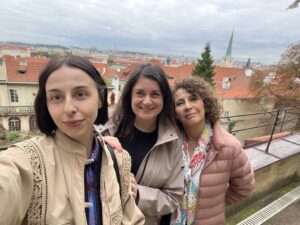
With an AJR heritage trip I went to Prague. There I went to the National Archives, the museums, and the memorials. I hit the ground running as I found the few missing Czechoslovak Kindertransport lists which weren’t in the Dutch files. The trip went from strength to strength from there. I visited the station the Kinder left from, I told Hanna Zack Miley on Zoom that a Kind who was meant to be taken in by her foster family before her had survived even though she was on the ninth transport which didn’t leave Prague, and I got to come face-to-face with the Kinder’s police files. I also went to the hotels where the rescuers in Prague stayed. I even got to sneak off with Hannah Goldstone one evening and visit the Golem café. Jewish Prague came alive for me. What I hadn’t planned for was the emotional trip to Terezin as I had discovered that some of the Kinder on the Prague lists who didn’t leave ended up here. I found their names in the children’s memorial in the museum. I told the staff and they didn’t know that the children were listed on Kindertransport lists. I also walked around knowing the blocks where some of the parents were sent to. Here I also got to return the Kindertransport lists to families. In a place which had taken lives, I hope that together with the team, I was helping to uncover and preserve their history and memory.
In Brussels I was alone on my research trip so after a day in the archives I walked the streets looking for the former offices and homes of the Kinder who were in the city – some were a stone’s throw from the archives. I wanted to plot my own mental map of Brussels Kindertransport history. In the archives I found all the Belgium Kindertransport lists and I went through the children’s case files. Now I could see connections between stories because of my archival work in different countries. I could trace Kinder from Vienna to Belgium. I could find the files of the Kinder Bea had interviewed who had fled to Belgium and then the UK. I also tragically followed their stories towards deportation. Throughout my research trips I’ve built friendships with the archivists who have continued to help me when I’ve returned home. I cannot thank them enough for their help and guidance. I still have many more trips planned to Sweden, Israel, and around the UK. I’ve been working in the International Tracing Service files at the Wiener Library which has opened new lines of inquiry. I hope to visit places such as Dachau as some of the Kinder were incarcerated there before fleeing on the Kindertransport. I know the blocks they were placed in, and I’d like to stand there with their photos and remember them.
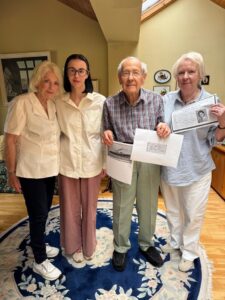
I knew when I started my role that I would be in direct contact with the Kinder and their families as we communicated about files. But what I’ve really enjoyed is being invited with Michael and Danny on Kinder home visits. I’ve sat in the Kinder’s homes which are full of their personalities, and we’ve been adding to the tapestries of their lives. The documents I’ve found have added to their puzzles. I’m not always able to solve them but I can certainly add more detail and confirm their important stories. What I also didn’t envisage was working with the dedicated social workers at the AJR. They work with the survivors, so they know them incredibly well and they often email me with inquiries and I’ve so enjoyed helping them to find more information. I’ve learnt a great deal from them, and I hope that it continues.
Some of my other activities include talks, conferences, reading second-generation manuscripts about their parents’ stories, and working with AJR partners such as the archives and practitioners. Since joining I’ve also filmed four documentaries in the UK, the Netherlands, France, and Germany. I’ve also been part of the monthly Kindertransport Zoom series which has looked at the new discoveries, newspapers, finances, and hostels, and there is so much more to come! What has been really special is working with the Education & Heritage team – Bea and Alex. Plus, I’ve been kept very busy filming social media content which is a totally new skill to learn! I’ve had countless discussions with Bea about revisiting the Kinder’s testimonies in relation to the new documents. We’ve also spoken about interviewing the next generations.
So, to sum-up it’s been a whirlwind of a year and it’s not stopping! It feels like I make new discoveries every day and I’m slowly seeing all the different Kindertransport material (UK, US, Canada, Switzerland, Sweden, France, Belgium, Netherlands, Australia, New Zealand, and so on) in relation. It’s a huge task but I’m grateful for the challenge and responsibility to turn this into exhibitions, books, commemorative events, and the Kindertransport database. Everyone at the AJR has been so supportive and I’m thankful for them. Most of all I’m looking forward to getting to know more of our members who graciously share their stories with me.
Dr. Amy Williams – AJR Kindertransport-Scholar-In-Residence