By Dr Bea Lewkowicz OBE, Director of AJR Refugee Voices
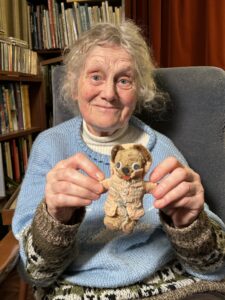
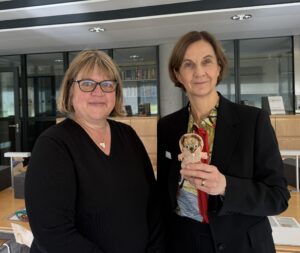
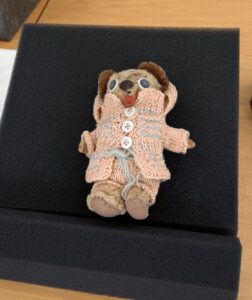
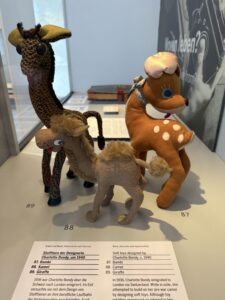
Last week, I had the pleasure of visiting the Deutsches Exilarchiv 1933–1945 at the Deutsche Nationalbibliothek in Frankfurt am Main. Many thanks to Dr Sylvia Asmus and her team for preparing the wonderful collection of handmade toy animals created by refugee designer Charlotte Bondy for me to see. I was particularly delighted to discover that Teddy Mary, who once belonged to Irene Auerbach, has now joined the collection. I first encountered Teddy Mary when I interviewed Irene for the AJR Refugee Voices Testimony Archive in April 2024. When Irene mentioned after the interview that she was looking for a permanent home for Teddy Mary, I put her in touch with the Deutsches Exilarachiv, and last year Irene travelled to Frankfurt to donate Teddy Mary and a selection of various handmade outfits, (such as a plastic raincoat) to the Archive.
Charlotte Bondy (1907–1986) was a German graphic designer who fled Nazi Germany in 1936 and settled in Britain with her husband, Paul Bondy. Like many refugees, she struggled to re-establish her professional career in exile. She began designing and making soft toys, creating a remarkable collection of handmade animals that reflected her artistic skills and creativity. One of these was Teddy Mary, made especially for Irene Auerbach to accompany her on a remarkable journey back to Germany in 1946.
Irene was born in Amsterdam in 1939 to German-Jewish political refugees Walter and Käthe Auerbach, who subsequently found refuge in Britain. Unlike many refugees who made Britain their permanent home, Irene’s parents were determined to return to Germany after the war. Having fled Nazi persecution, they believed they had a responsibility to help rebuild a democratic Germany. In October 1946, the family returned to Germany, accompanied by seven-year-old Irene and her beloved Teddy Mary.
Irene’s father, Walter Auerbach (1905–1975), a committed Social Democrat and trade unionist, went on to play an important role in postwar Germany. From 1948 to 1971, he served in senior positions in the Lower Saxony Ministry of Labour and Social Affairs, contributing to the reconstruction of democratic institutions and social policy. His brother, Philipp Auerbach (1906–1952), also returned to Germany after surviving Nazi persecution and imprisonment in concentration camps. He became State Commissioner for People Persecuted on Racial, Religious and Political Grounds in Bavaria, working to secure assistance and restitution for survivors. His life ended tragically in 1952, following accusations of financial misconduct. He was posthumously exonerated in 1954.
The stories of Walter and Philipp Auerbach highlight a less frequently discussed aspect of refugee history: the decision of some German-Jewish refugees and survivors to return to the country from which they had been persecuted, determined to help build a different Germany. For me, seeing Teddy Mary preserved in Frankfurt was particularly moving. This small handmade bear connects the stories of a refugee toy maker in Britain, a young girl returning to Germany and a family committed to rebuilding democratic society after the Holocaust.
Teddy Mary also features in the AJR’s 80 Objects/ 80 Lives exhibition.