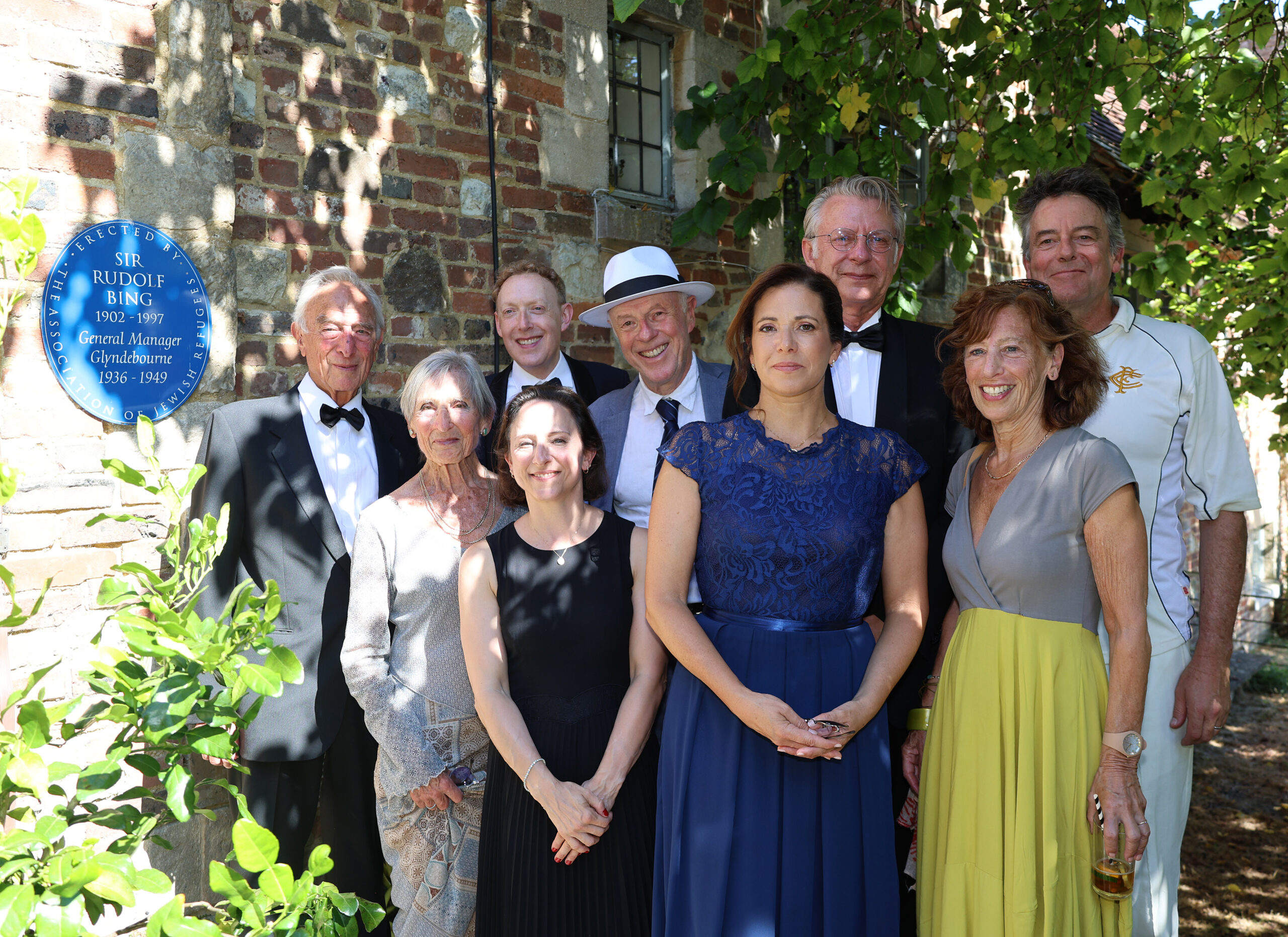
Wednesday 12 August 2026, East Sussex: The Association of Jewish Refugees (AJR) today marked the tenth anniversary of its Blue Plaque honouring Sir Rudolf Bing at Glyndebourne, bringing together Holocaust refugees, survivors, descendants, diplomats and members to celebrate the extraordinary legacy of one of the most influential refugee figures in the history of opera.
The event commemorated a decade since the AJR unveiled its Blue Plaque at Glyndebourne in recognition of Bing’s outstanding contribution to British cultural life. Forced to flee Nazi Austria in 1934, Bing became General Administrator of Glyndebourne before going on to transform the Metropolitan Opera in New York into one of the world’s leading opera houses during a 22-year tenure as its General Manager.
Among the distinguished guests were the Austrian Ambassador to the United Kingdom, Bernhard Wrabetz, and his wife Joana Wrabetz, who joined AJR members in recognising Bing’s enduring legacy and the lasting contribution of Jewish refugees to the cultural fabric of Britain.
The celebration was made even more special by the attendance of AJR members Maurice Peltz and Maria Ault, who will both celebrate their 100th birthdays this November. For Maria, the occasion held particular personal significance. Her mother, Henriette Bewersdorff, was a celebrated opera singer in Germany before the family fled Nazi persecution, making the anniversary celebration at Glyndebourne a poignant connection to her family’s musical heritage. Their presence served as a powerful reminder of the generation whose resilience, achievements and stories continue to inspire future generations.
Remarking on the occasion, Maria Ault said: “This has been a very special day for me. My mother was an opera singer before we escaped Nazi Germany, so being at Glyndebourne to honour Rudolf Bing feels like a wonderful tribute to the courage and achievements of so many Jewish refugees.”
Guests gathered for a welcome reception before assembling at the AJR Blue Plaque, where they heard from Gus Christie, Executive Chairman of Glyndebourne and grandson of the festival’s founders, John Christie and Audrey Mildmay. Speaking beside the plaque, Christie reflected on Rudolf Bing’s pivotal role in shaping Glyndebourne during its formative years and his enduring influence on the international opera world.
AJR member and former Trustee Frank Harding MBE, who founded the AJR Blue Plaque Scheme, also addressed guests, reflecting on Bing’s remarkable journey from refugee to one of the twentieth century’s most influential arts administrators and the wider contribution Jewish refugees have made to Britain.
Following the commemorative ceremony, guests attended Glyndebourne’s acclaimed production of Ariadne auf Naxos by Richard Strauss, conducted by Robin Ticciati with the London Philharmonic Orchestra.
The AJR Blue Plaque Scheme was established by Trustee Frank Harding to recognise the exceptional achievements of Jewish refugees who rebuilt their lives in Britain after fleeing Nazi persecution. Since the first plaque was unveiled in 2013, the scheme has grown to include 19 plaques across the UK and internationally, commemorating pioneers in science, medicine, education, music, public life and humanitarian rescue.
Sir Rudolf Bing is uniquely honoured with two AJR Blue Plaques. Alongside the Glyndebourne plaque unveiled in 2016, a second plaque was unveiled in Edinburgh in 2017 recognising his role as founder of the Edinburgh International Festival.
The most recent addition to the scheme commemorates the British Committee for Refugees from Czechoslovakia and the Czech Refugee Trust at Goodenough College in London. The AJR expects to unveil its next Blue Plaque at Wigmore Hall in honour of the Amadeus Quartet.
Speaking at the unveiling, Frank Harding MBE, said:
“Returning to Glyndebourne ten years after unveiling the Rudolf Bing Blue Plaque was a fitting opportunity to celebrate the remarkable legacy of a man whose vision transformed the world of opera. Bing’s journey from refugee to one of the twentieth century’s most influential cultural leaders embodies exactly what the AJR Blue Plaque Scheme seeks to recognise – the extraordinary contribution that Jewish refugees made to Britain after escaping Nazi persecution.”
He added:
“Each plaque tells a story of strength, talent and achievement. Together, they ensure that the lives and contributions of Jewish refugees remain visible in the places where history happened. As we mark the tenth anniversary of this plaque and continue to expand the scheme, we are preserving not only individual legacies but an important chapter of British history that deserves to be remembered by future generations.”
The AJR continues to expand its nationally recognised Blue Plaque Scheme as part of its wider mission to preserve the legacy of Jewish refugees while supporting Holocaust survivors and their families today. Alongside providing essential social welfare and care services, the AJR funds Holocaust education, combats antisemitism and preserves one of Britain’s most significant collections of refugee testimony. Home to the UK’s largest community of descendants of Jewish refugees and Holocaust survivors, the AJR is committed to ensuring these stories continue to educate and inspire future generations.